
Internal Auditor Salary & Pay
Internal auditors are a company’s in-house watchdogs—trusted insiders who test controls, hunt for misstatements, and reassure boards that the numbers can be believed. Because they sit between finance, risk, and compliance, organisations pay a premium for their independence and credibility. Most firms operate an implicit hierarchy: no financial operations role can out-earn the professionals who certify its accuracy, so senior internal auditors often rank just below treasury and controller posts in the salary charts.
The scarcity of multidisciplinary talent buoys their compensation: candidates must blend accounting rigour with investigative flair and regulatory savvy. Add in the cost of certification (CIA, ACCA, CPA) and the exposure they get to every corner of the business, and it’s clear why internal auditors command solid, risk-adjusted pay cheques across Europe.
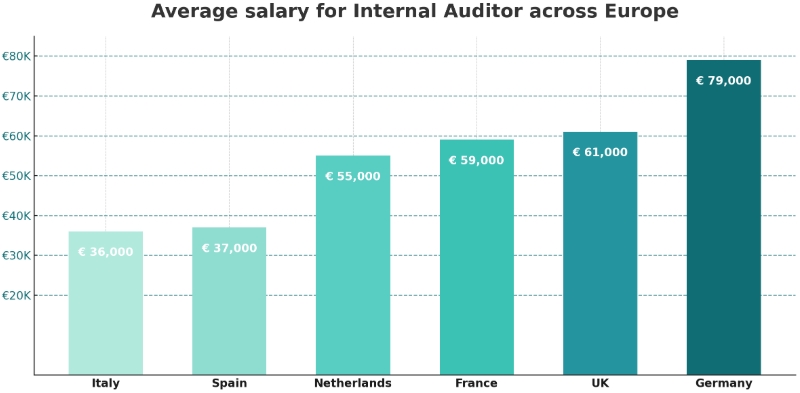
Internal auditors sit at the intersection of risk management and financial stewardship, and their compensation reflects both the complexity of the role and local market conditions. 2025 compensation data show a wide span across Europe: entry-level figures cluster in southern markets, with Italy averaging approximately €36,000 and Spain close behind at €37,000 per year. Moving north, remuneration increases sharply—internal auditors in the Netherlands earn approximately €55,000, while those in France command nearly €59,000.
Anglo-Saxon and Germanic markets top the league table. In the UK, the average package is now around €61,000 (after converting from the latest pound-euro rate), while Germany leads the region at roughly €79,000—more than double the Spanish average. The chart above visualises the countries from lowest to highest salary, making it easy to spot both the north-south pay divide and the premium that Germany’s talent market assigns to audit expertise.
Salaries may vary depending on the industry, experience, and company policies. We based the above figures on estimates from Glassdoor.co.uk.

Internal Auditors’ Salary and Pay
The salaries mentioned above are for entry-level roles. They are for professionals with less than five years of experience. As you gain experience, you can expect your compensation to increase proportionally. At the top end, Chief Internal Auditors can make anything from EUR 150,000 to EUR 400,000 at some companies.
Large international corporations tend to pay more than smaller businesses. They also offer more benefits. The most effective way to increase your compensation is by making lateral moves within companies, transitioning from one role to another. Grab any growth opportunities. We do not mean annual job hunts, but we are open to options that suit your profile.
Most of the compensation for internal auditors is in the form of a fixed annual package. As a cost centre, incentives and bonuses are typically modest, ranging from 10% to 20% early in your career. More senior roles have a slightly higher bonus range, but it won’t be a significant part of your compensation.
Sector and Location Considerations
Compensation also varies by industry. Banks, Big Four consulting firms, and large Fortune 500 companies tend to pay more. They have complex operations that require advanced skills and experience.
Total compensation is also dependent on your location. Roles in large cities or the capitals of financial hubs usually pay 10% to 20% more to compensate for the higher cost of living. Businesses in such towns are also likely to be more prominent, with a larger global footprint. This offers more opportunities for lateral movements and corresponding salary increments.
Future Prospects for Internal Audit
Internal audit is an “in-demand” role owing to the increasing regulatory complexity worldwide. Companies have had to focus increasingly on compliance, governance, and control due to the rise of fraud and cybersecurity breaches. They also face a more competitive business environment. Internal audit teams play a crucial role in this process. Companies worldwide have been hiring more skilled internal auditors. They are also increasing team sizes.
The work has also changed, with a greater focus on technology and data-driven approaches. This means that tech-savvy candidates can command higher salaries. They can also expect larger annual raises. It is advisable to get the necessary tech training to fast-track your career.
Learn more about internal audit careers:
See our other articles on the role of an internal auditor, including Job Description, How to Become, Qualifications, and CV.
Search for Jobs to learn about the internal auditor job roles we currently have available.
Job Seekers
On the hunt for your next role? Upload your CV below and we’ll be in touch to discuss your requirements.
Employers
For employers seeking the right skills and cultural fit for your business, send us your vacancy to find out more about how we can help.
Submit CV Send Us Your VacancySearch Jobs
Popular this week
- How Does Industry 4.0 Differ From The Previous Generation?
- What Qualifications And Skills Are Needed To Be An Accountant?
- What Are The Main Differences Between ACA and ACCA?
- Top 10 Skills For A Successful Finance And Accounting Career
- Agile For Accountants: Six Steps To Provide Necessary Tools And Relevant Processes